The history of Tuam
A burial mound by a river ford, a monk whose chariot wheel is said to have broken here, the seat of the last high kings of Ireland, the first stone castle in the country, and a market square that has kept its 1613 plan. 17 moments, in order.
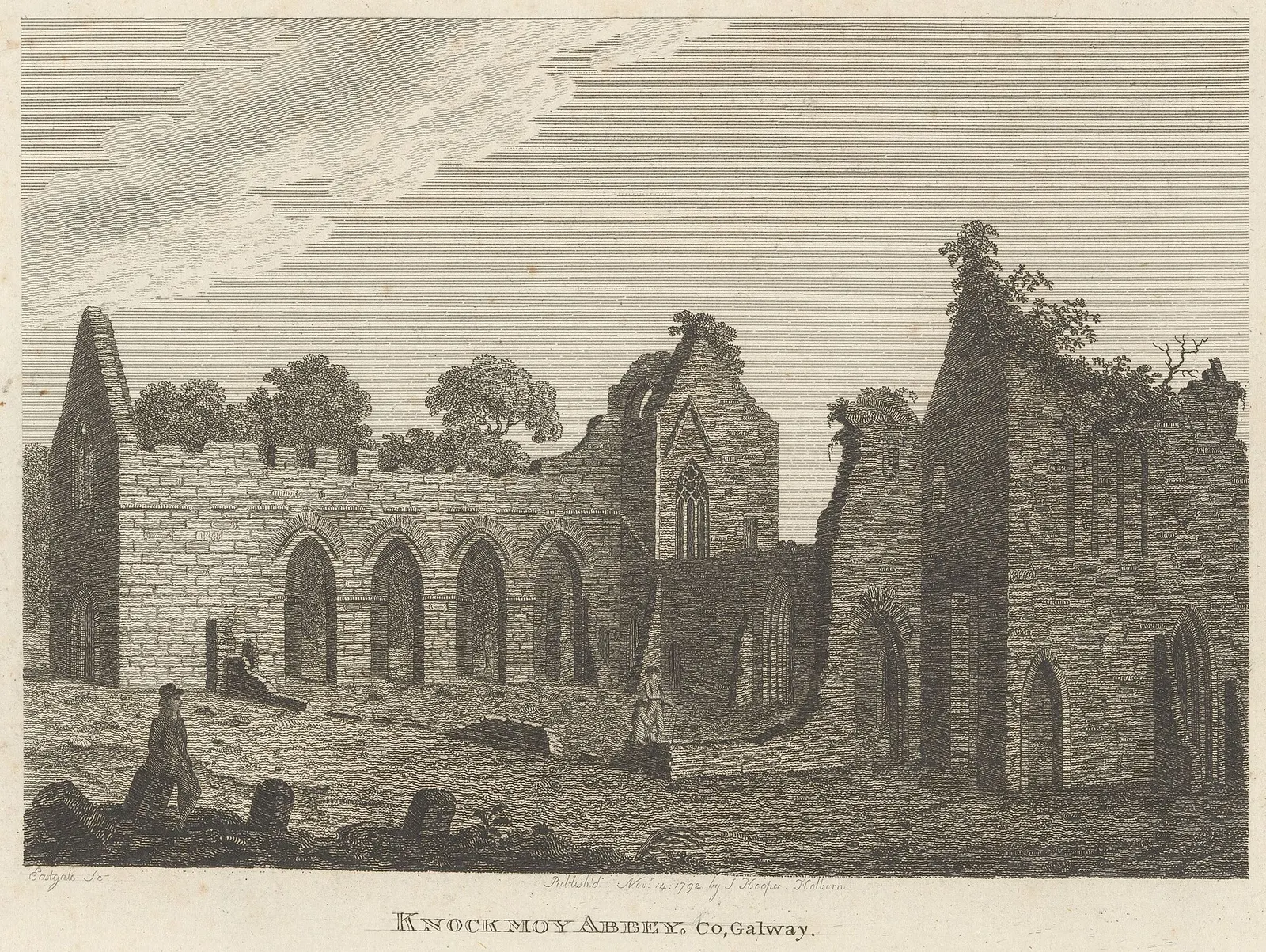
Rijksmuseum, CC0 via Wikimedia Commons
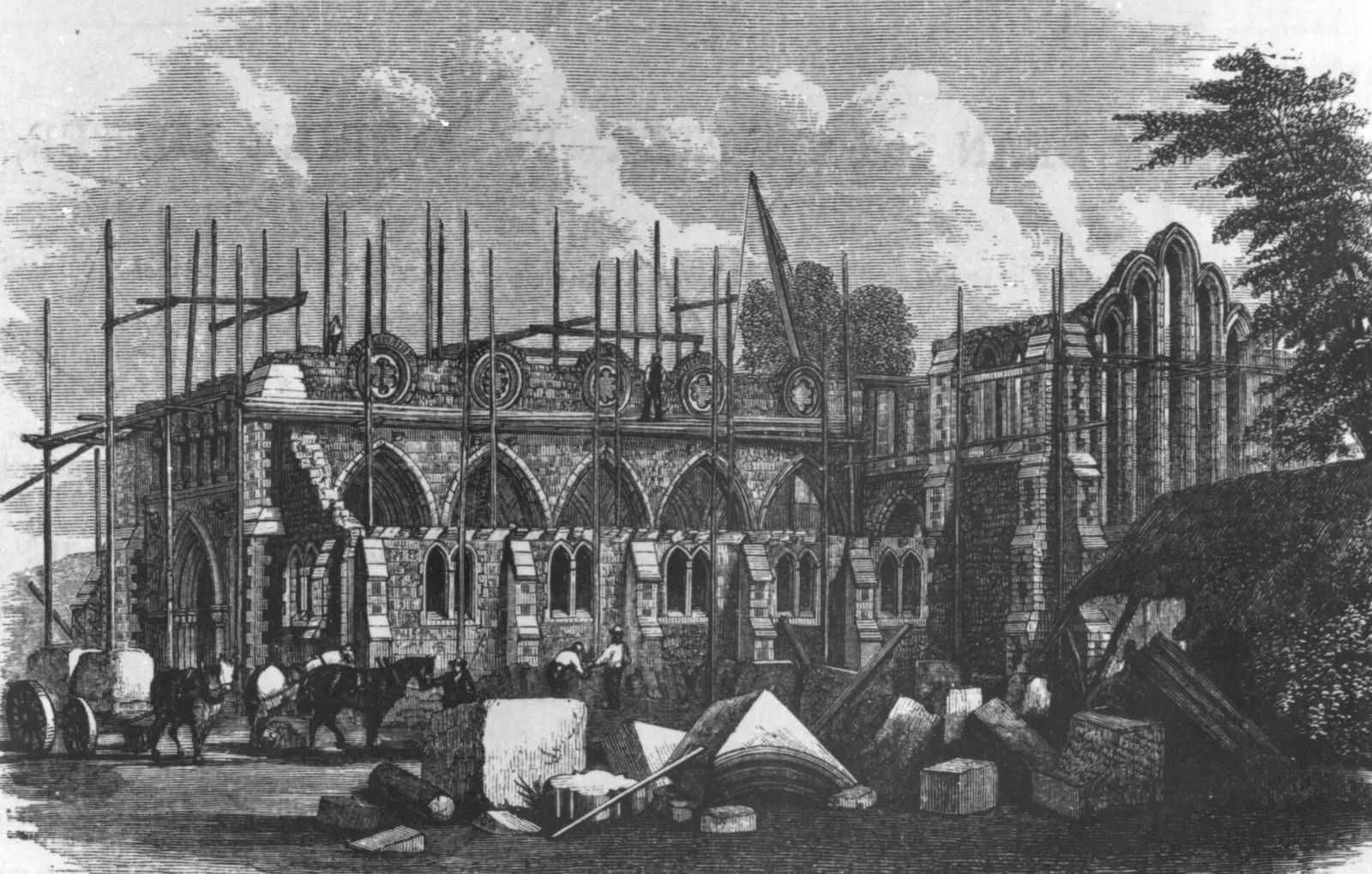
Unknown photographer, public domain via Wikimedia Commons
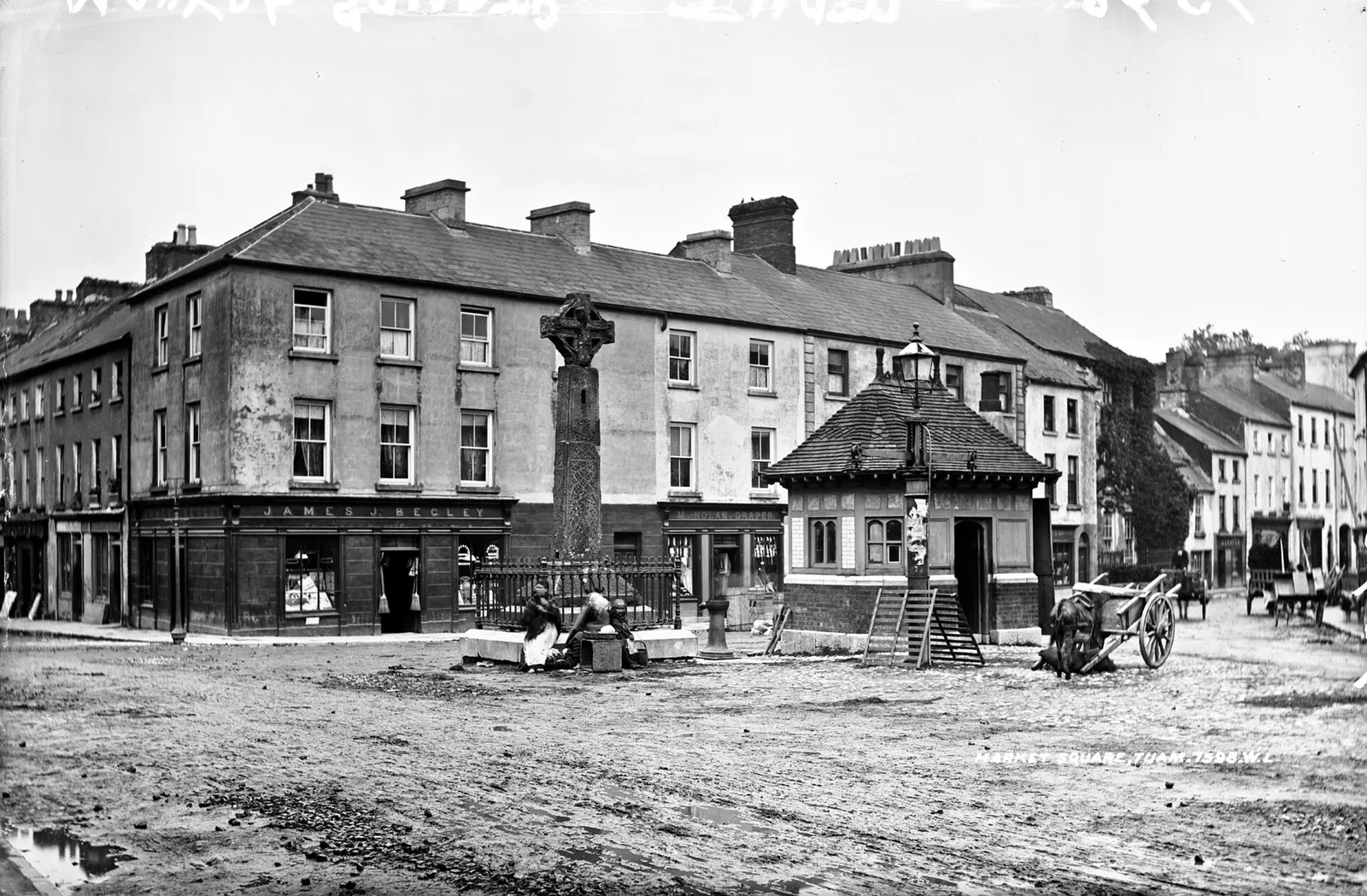
Robert French, no restrictions via Wikimedia Commons
- Bronze Age
A burial ground by the river
People have lived here since the Bronze Age: ground beside what is now Shop Street was used as a burial place, and in 1875 workmen found a Bronze Age burial urn there. The name Tuam is cognate with the Latin tumulus, a burial mound; the old name, Tuaim Dá Ghualann, means the mound of two shoulders, probably the high ground either side of the River Nanny at a fording point.
- About 526
Jarlath's monastery
Records from the early sixth century mention a monk called Jarlath at Cloonfush, 6 km west of the town. The Life of Brendan tells how Brendan sent him off in a chariot to settle wherever its hind shafts broke; the wheel is said to have broken at Tuam, and Jarlath founded a monastery, the School of Tuam. The article notes there is no evidence the wheel actually broke here; more likely Jarlath chose ground that was already settled. The broken wheel is on the town's coat of arms to this day.
- 1049
The O'Connors make it a stronghold
Aedh O'Connor defeated the King of Iar Connacht, made the O'Connors kings of Connacht, and built a castle at Tuam as his principal stronghold. That decision is what made the town matter.
- 1106 to 1156
Seat of the High King
During Tairrdelbach Ua Conchobair's fifty-year reign Tuam was the centre of provincial power and, from 1128, the seat of the High King of Ireland, a title he took by force of arms. He founded an Augustinian priory here about 1140, and his patronage brought the town masterpieces of Celtic art such as the Cross of Cong.
- 1152
An archbishopric, and the High Cross
At the Synod of Kells Tuam was raised to an archbishopric, with Áed Ua hOissín as its first archbishop. The High Cross of Tuam was erected the same year, possibly to mark his appointment; its base asks for a prayer for O'hOisín. It is reputed to have been the tallest high cross in Ireland.
- 1164
The first stone castle in Ireland
Ruaidrí Ua Conchobair, the last native High King, had a "wonderful castle" built, with lofty walls and a deep moat fed by diverting the river. It was the first Irish-built stone castle; a small part of it still stands.
- 1184
Fire, and a long quiet
The first cathedral was destroyed by fire and collapsed. Ruaidrí left Tuam for Cong Abbey, taking the cathedral's valuables into the abbot's care, and the town shrank to a small settlement. It did not begin to grow again until the early seventeenth century.
- 1252
Fairs and markets
Tuam has always been a market town. A fair granted by letters patent from Henry III to Archbishop MacFlynn dates from 1252; later fairs were authorised by charters from James I and George III.
- 1613
A royal charter and the Square
On 30 March 1613 James I granted Tuam a charter: two members in the Irish House of Commons until 1801, and a council of a sovereign and twelve burgesses. The town was laid out as a market town to its present plan, every street converging on the central square. The sovereign was sworn in at the Chair of Tuam, believed to lie within the remaining tower of Ruaidrí's castle.
- 1800
St Jarlath's College
The college was founded in 1800. It has since won the Hogan Cup, the national schools' Gaelic football championship, a record twelve times.
- 1827 to 1837
The Cathedral of the Assumption
The Roman Catholic cathedral, seat of the Archdiocese of Tuam, was built over these ten years. The Tuam Herald followed in 1837, founded by Richard Kelly; it is County Galway's oldest newspaper.
- 1852 to 1874
Two churches, one cross
The High Cross went to Dublin for the Great Exhibition of 1852. Before it came home, Catholic Archbishop John MacHale and Church of Ireland Dean Charles Seymour each claimed it; the compromise put it halfway between the two cathedrals, visible from every main street, where it stood in the Square from 1874. St Mary's Cathedral, the Church of Ireland one, was built 1861 to 1878 around a twelfth-century arch and a fourteenth-century chancel.
- 1860 to 1978
The railway
Tuam station opened on 27 September 1860 on the Athenry to Sligo line. It closed to passengers on 5 April 1976 and altogether on 18 December 1978; the line had carried sugar beet to the Irish Sugar factory off the Ballygaddy Road. The station building still stands. John Wayne's arrival in The Quiet Man was filmed at Ballyglunin, about 6 km away.
- 1920
The War of Independence
In July 1920 the Town Hall and other property were attacked and badly damaged by armed Royal Irish Constabulary men, the day after two RIC men were killed in an IRA ambush near the town.
- 1960s
The showband capital
In the 1960s Tuam was known as the Showband Capital of Ireland, home to the Johnny Flynn Showband among others. The Saw Doctors, the town's best-known band, came later; The Rocky Road to Dublin, popularised by The Dubliners, follows a man from Tuam on his way to Liverpool.
- 1980s
The Chair and the Cross
The Chair of Tuam monument was unveiled in May 1980 by Cardinal Tomás Ó Fiaich, and in the same decade the High Cross was moved indoors, into the south transept of St Mary's Cathedral.
- 2017
The bypass
The M17 motorway, bypassing the town to the west, opened ahead of schedule on 27 September 2017. Its design includes a bridge over the closed railway so the line could reopen.
Where this comes from
Every paragraph above summarises a statement in Wikipedia, "Tuam", licensed CC BY-SA 4.0, as it read on 2026-09-18. The article cites the Annals, the Life of Brendan and local histories; follow it for the footnotes. Nothing has been added from memory.